

In short
- Rereading a text is your mind trying to fill a gap in information, not proof that something is wrong.
- Short, flat messages feel loud because they carry no tone, and your mind supplies one.
- Name the loop, write three possible meanings, set a limit and reply with one clear line.
It is 9:52 p.m. You sent a message an hour ago: a thoughtful one, with a question and a little joke. The reply just arrived.
"Sounds good."
That is all. No exclamation point. No emoji. No "can't wait." You read it once, then again. You wonder if the period was cold. You scroll up to see how they usually write. You open the chat on your phone, then on your laptop, as if the words might have changed.
Twelve rereads later, you are no closer to knowing what they meant. You are only more sure that something is wrong.
You already know it is probably nothing. That is not the problem.
What is happening in your head
Text messages are strangely bare. There is no tone of voice, no face, no pause, no laugh. You are left with a few words and a lot of room.
Research on written messages points the same way. In a series of studies on e-mail by Justin Kruger and colleagues, senders were typically overconfident that their intent was understood, and misunderstandings were common even between people who knew each other. Without body language or vocal inflection, the reader supplies the tone from their own point of view, and a worried reader supplies a worried tone.
Your mind also dislikes the gap. Researchers talk about intolerance of uncertainty, the discomfort some of us feel when we cannot know how something will turn out. A 2011 meta-analysis found that it goes with symptoms of generalized anxiety, depression and obsessive-compulsive disorder. When not knowing is hard to bear, many people find that the mind rushes to fill the gap with the explanation it feels it has to prepare for, and that is often the worst one.
In cognitive behavioral therapy, one of the common thinking patterns has a plain name: mind reading. It means assuming you know what someone else thinks, usually something negative about you, with little or no real evidence. "They're annoyed." "They've lost interest." "I said something wrong." It feels like insight. It is usually a guess made while anxious.
A short message is not a verdict. It is a gap, and your mind is filling it with the loudest story it can find.
Why a tiny text can feel so big
A few things can turn a two-word reply into a whole evening:
- Missing tone. "Fine" and "fine." can read as friendly or furious. You supply the tone yourself, and tired, worried minds tend to supply a harsh one.
- Past hurts. If someone once pulled away without explanation, it makes sense that you notice small shifts. The radar may once have protected you. Now it can trigger on a period.
- The stakes are high. The more you care about the person or the outcome, the more weight each word carries.
- You are depleted. When you are tired, stressed or lonely, many people find that ambiguous things feel more threatening than they are.
- Apps built for checking. Seen, typing, last online, read receipts: these features give you endless new "evidence" to examine, and none of it settles anything.
Notice that none of this says you are dramatic or needy. It describes a caring mind with too little information and too much time.
The loop that keeps you stuck
Rereading feels like a way of getting closer to the truth. In practice it is a loop, and every lap makes it a little stronger.
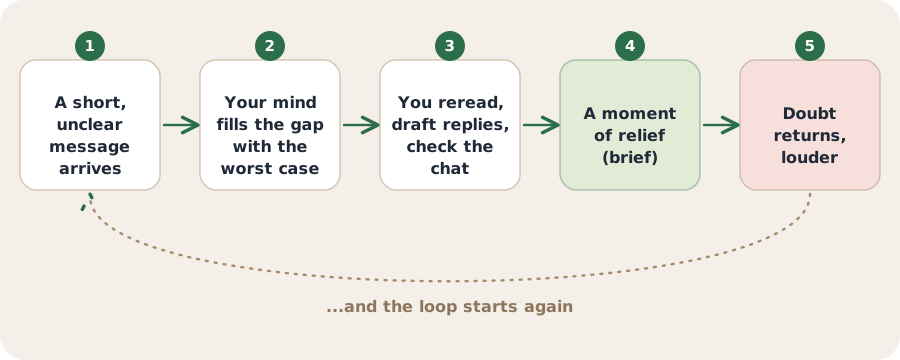
The loop works because relief is real, but short. In a 2015 survey of people with obsessive-compulsive disorder and panic disorder, reassurance brought short-term relief, followed by a later return of discomfort and a stronger urge to ask again. Healthy comparison participants did not show that rebound. It was a self-report study of people with those conditions, so rereading a text is only a mild everyday cousin. But the pattern fits: each reread or screenshot sent to a friend calms things for a few minutes, and your mind learns to ask sooner. This is how a worry becomes a habit.
If this sounds like you
If you have ever typed a reply, deleted it and typed it again, you know it. If you have screenshotted a chat to ask a friend "what do you think they meant?", you know it. If a slow reply makes you list everything you might have done wrong, you know it.
It tends to show up with new relationships, with people you feel unsure about, with bosses and friends, and with family. It often travels with anxiety, perfectionism and a habit of putting other people's feelings first. It also shows up in strong, capable people, because it has little to do with how competent you are.
Overthinking a text rarely says anything about the person who sent it. It says something about how much you care and how tired you are.
What the same text can mean
Take one message: "Sure, see you then." Here are some of the ways it can be read.
| Your mind's reading | A simple alternative |
|---|---|
| "She sounds cold." | She is typing fast between meetings |
| "She doesn't want to come." | She is saying yes in her usual style |
| "I did something wrong." | She had nothing else to add |
| "She's annoyed I asked." | She is agreeing, and the message is done |
None of these is certain. That is the point. The message is short, and the meaning you add comes from your mood, your history and your day, not from the words.
What people try instead of waiting
| What people try | What happens |
|---|---|
| Rereading until you feel sure | Certainty is not in the text. Every lap gives you a few minutes of calm and a deeper groove. |
| Sending a quick "Is everything okay?" at 11 p.m. from a panic | It might be the right question later, but sent from anxiety it can read as pressure. |
| Asking five friends to decode it | One trusted opinion can help. A group chat of theories gives your mind more material. |
| Checking "last seen" or "read" | That feature is built to produce one more tiny clue, and clues feed the loop. |
| Telling yourself to stop | A meta-analysis found a small to moderate rebound when people suppress a thought, though the size varied. It is an unreliable tool. |
Six ways out of the loop
You cannot control what they meant. You can change what you do with the gap. Try these in order and stop when one works.
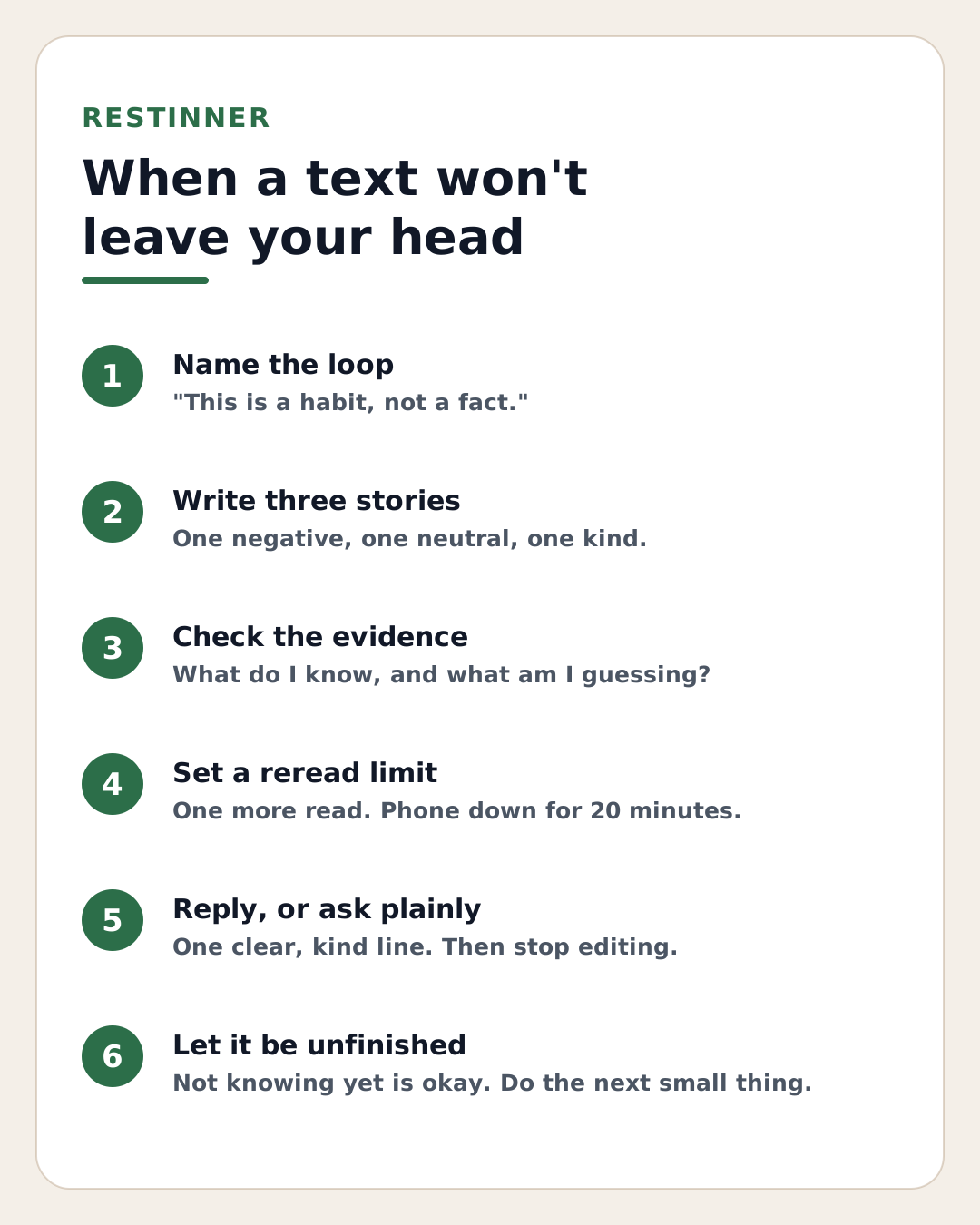
1. Name the loop
Tell yourself, "I'm in the reread loop. This is a habit, not a fact." Naming it gives you a little distance. You are no longer inside the thought, you are noticing it.
2. Write three stories
Write down three possible meanings: one negative, one neutral and one kind. For "Sounds good," that might be: "They're annoyed." "They're busy and typing fast." "They're comfortable and keeping it short." Seeing all three on paper reminds you that the worst one is only one of many.
3. Check the evidence
Ask: what do I actually know, and what am I guessing? "They replied within an hour" is evidence. "They don't like me" is a guess. Keep a list of facts on one side and guesses on the other. This is the standard way to test a mind-reading thought: list what you actually observed, and what else could fit the same facts.
4. Set a reread limit
Allow yourself one more read, then put the phone down for twenty minutes, in another room if you can. Do something with your hands: dishes, a shower, a walk. The urge peaks and fades, usually faster than you think.
5. Reply plainly, or ask plainly
If a reply is needed, send one clear, kind line and stop editing. If something truly matters, ask directly, in daylight, without drama: "Hey, I wasn't sure how that landed. Is everything okay on your end?" A plain question beats a week of silent theories.
6. Let it be unfinished
You may not get an answer tonight. "Not knowing yet" is a place you can stay. Choose one small next thing, like brushing your teeth, and do it.
Messages you can send instead of rereading
If the uncertainty bothers you, a plain question is often kinder than a theory.
- "Just checking: is Saturday still good?"
- "I wasn't sure how that last message came across. Everything okay?"
- "Thanks for the reply. I'd love to hear more when you have time."
- "I was a bit unsure about my tone earlier. Did it come across the way I meant?"
Asking once is clearer than rereading twelve times. If the answer is reassuring, you have it. If not, you have real information.
A reread limit
When the urge to reread arrives, try a rule:
- Read it once, for facts. Who, what, when.
- Read it once more, for tone, if you need to. Then stop.
- Set a ten-minute timer before the next look.
- Do something with your hands: wash a cup, fold a towel, take a short walk.
- After ten minutes, ask yourself if you still need to reread.
Most of the time, the urge fades by then. If it does not, that is useful information too.
When the reply is late, not short
The same loop runs on silence. An hour passes, then three, and the lack of a reply starts to feel like a message of its own.
Try the same moves: write the three stories (busy, distracted, annoyed), pick the most ordinary one and give yourself a time to check again, such as after dinner. A plain follow-up can wait until tomorrow without costing you anything. Most replies that are late are late for reasons unconnected to you.
Common obstacles
"I have to know what they meant." You may never know. Choose between asking directly and letting it be, and then practice one of them.
"I reread to feel safe." Rereading gives a brief calm and teaches your mind to ask again. That is the loop. Try shortening it a little each day.
"I check even after they have answered." The loop does not need new information. Set the reread limit and put the phone in another room.
"I overanalyze texts from people I love." That is common. Closeness can raise the stakes, and the pattern is about how much the message matters to you.
The unanswered "okay"
Picture this. It is 9:52 p.m., and you are holding the phone again.
"Sounds good." You notice you are on your sixth read. You tell yourself, "I'm in the loop." You write three stories on the back of an envelope: annoyed, busy, comfortable. The second and third are just as likely as the first.
You allow one more read. Then you put the phone in the kitchen and wash the two cups that have been in the sink. Twenty minutes pass. The urge dips. You come back, type "Great, see you Thursday," and leave it.
Nothing about this was dramatic. It is also what a calmer mind looks like: not one that never wonders, but one that knows what to do when it does.
What else it can be
Rereading a message is usually a passing habit. A few things can make it heavier.
Relationship anxiety. If you are constantly watching for signs that someone is pulling away, and a flat message sets off a fear of being left or rejected, the text is only the trigger. The fear underneath is the bigger thing, and it tends to show up in other places: waiting for calls, reading moods, needing frequent reassurance.
Anxiety more broadly. If checking and rereading take up hours, if you cannot focus at work or sleep because of it, the loop may be part of a wider pattern of worry. Overthinking vs Anxiety describes what to notice.
Checking that has become a ritual. For some people, the urge is less a thought and more a pull: reread it exactly this many times, check it again after brushing your teeth. When the relief is brief and the pull comes back stronger, the loop is running on the urge and not the message.
Old hurts. Past experiences of being dropped, ignored or criticized can make a small, ambiguous signal feel large. The reaction is not silly. It is a memory that is still on duty.
Noticing which description fits is useful, and it does not require a label. How often it happens, how long it lasts and how much it costs you tell you the rest.
Most flat messages are about the other person's day, not about you. Most people are thinking about their own evening far more than they are analyzing yours. The relief you are looking for does not live in the text. It lives in what you do next.
Try this today
The next time a message sets off the loop, take a piece of paper and write three stories: one negative, one neutral, one kind. Then put the phone in another room for twenty minutes.
When you come back, send one clear line, or none at all. Then say, quietly, "That was enough."
FAQ
Why do I overanalyze texts, even from people I trust?
Because the issue is the missing tone and your sensitivity to small changes, not the person. Trust in someone does not stop your mind from filling a gap when the words are short. It is very common, especially when you care about the person or when you are tired or anxious, and it is worth attention only when it takes up a lot of time or distress.
Should I ask them directly what they meant?
Sometimes. If it truly matters and you can ask calmly and plainly, it is usually kinder and clearer than guessing. If you are in the middle of a spiral, wait until the urge settles before you ask.
Does this mean I have relationship anxiety?
Not by itself. Everyone overthinks a message now and then. If it happens constantly, with a strong fear of being left or rejected, it is worth tracking how often it appears and how long it lasts. That gives you a clearer picture than any single night.
How do I stop checking my phone, and how long until it gets easier?
Put it in another room for a set time, do something with your hands and decide in advance when you will check. Many people notice a difference within a couple of weeks of practicing the reread limit, because each time you wait out the urge, it loses a little of its pull.
Is it rude to ask what someone meant?
Not if you ask kindly and plainly. "I wasn't sure how that read. Everything okay?" is usually welcome. It tends to be easier on both of you than silence.
Was this page helpful?
Thank you for your feedback.
Sources
- Gentes, E. L., & Ruscio, A. M. (2011). A meta-analysis of the relation of intolerance of uncertainty to symptoms of generalized anxiety disorder, major depressive disorder, and obsessive-compulsive disorder. Clinical Psychology Review, 31(6), 923-933. pubmed.ncbi.nlm.nih.gov/21664339
- Kruger, J., Epley, N., Parker, J., & Ng, Z.-W. (2005). Egocentrism over e-mail: can we communicate as well as we think? Journal of Personality and Social Psychology, 89(6). Summarized in NYU Stern, E-mail etiquette: more critical than you might think. stern.nyu.edu
- Salkovskis, P. M., & Kobori, O. (2015). Reassuringly calm? Self-reported patterns of responses to reassurance seeking in obsessive compulsive disorder. Journal of Behavior Therapy and Experimental Psychiatry, 49, 203-208. researchportal.bath.ac.uk
- Bonfil, A. Cognitive distortions: mind reading. CogB Therapy (2026). cogbtherapy.com
- Abramowitz, J. S., Tolin, D. F., & Street, G. P. (2001). Paradoxical effects of thought suppression: a meta-analysis of controlled studies. Clinical Psychology Review, 21(5), 683-703. doi.org/10.1016/S0272-7358(00)00057-X