
In short
- Bed is where the pull is strongest: you are tired, the phone is already in your hand and the content is emotionally charged.
- Surveys and cross-sectional studies link bedtime phone use, doomscrolling and problematic news habits to worse sleep. They cannot show what causes what.
- By 11 p.m. your decision-making is tired, so use a short ladder of steps and a three-minute landing routine rather than willpower.
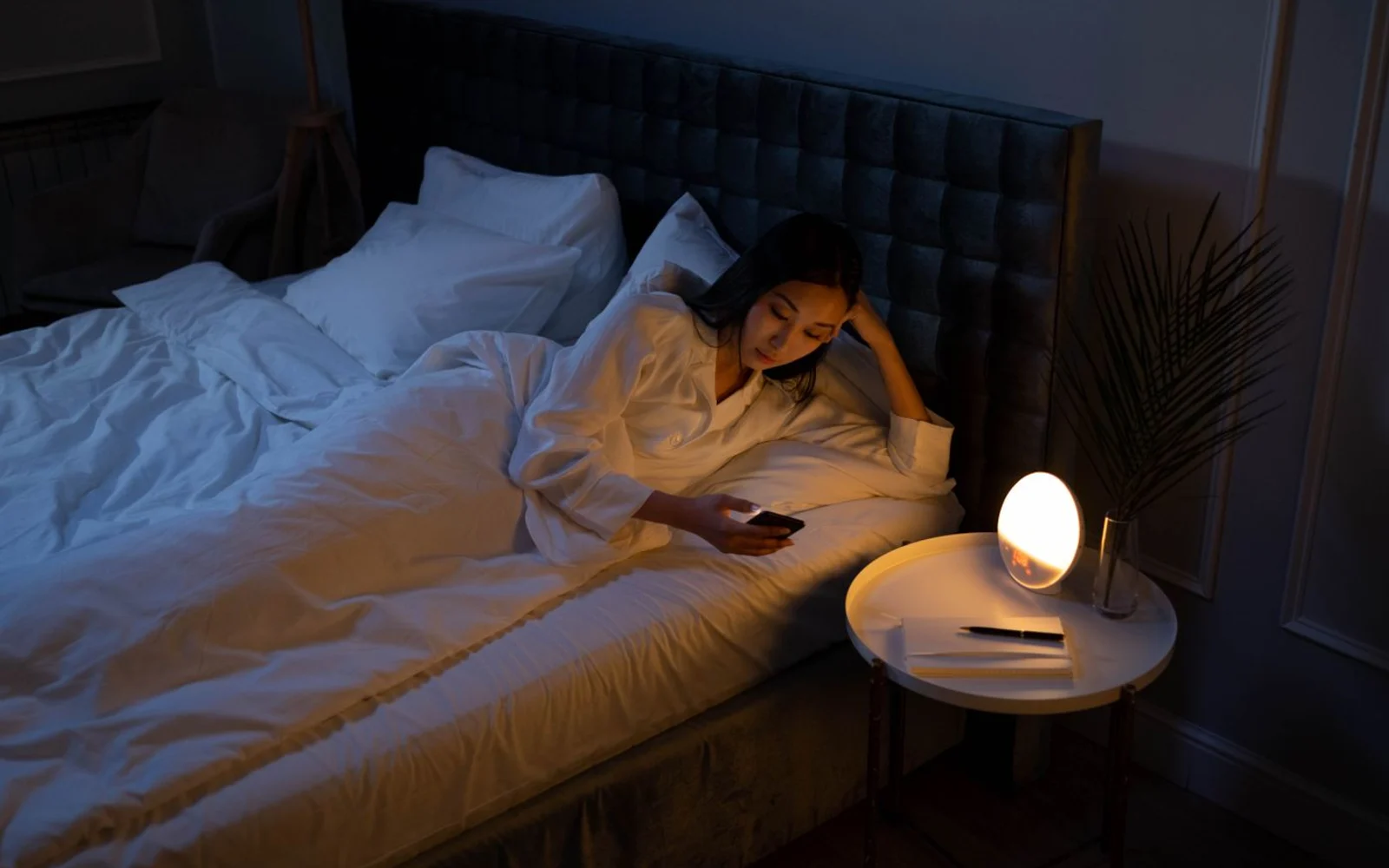
It is 11:48 p.m. You are in bed, lamp off, phone about eight inches from your face. You told yourself five minutes.
A headline about a city budget. A thread of strangers arguing about something none of them can settle. A video tour of a seventh-floor apartment you cannot afford. Your thumb moves on its own.
When you look up, it is 12:34. Your eyes are dry, your jaw is set, and you feel less rested than when you got into bed. Somehow you are also wider awake.
If that is how your nights end, you are not short on willpower, and you are not uncaring about the world. The habit in general, and the comparison that rides along with it, is covered in our guide to social media comparison and doomscrolling. This article stays with a single hour: the one in bed, with the phone already in your hand.
Doomscrolling at night is scrolling through upsetting news or posts late in the evening, often in bed and often past the time you meant to sleep. It feels like staying informed or winding down, but it can keep the mind switched on at the hour it most needs to power down.
Why the pull is strongest in bed
Doomscrolling at lunch is a habit. Doomscrolling in bed is a habit plus four things working against you.
You are tired. In a community survey of 177 people, Kroese and colleagues defined bedtime procrastination as failing to go to bed at the intended time while no external circumstances prevent it. People with weaker self-regulation reported more of it, and more of it went with more self-reported insufficient sleep. It was a survey, so it shows an association, but it matches the experience: by night, the part of you that decides to stop has done a full day's work.
The phone is already in your hand. In the American Academy of Sleep Medicine poll described below, half of U.S. adults said they use a screen in bed every day. A habit that lives in bed needs no decision to start. You do not choose to scroll. You simply do not choose to stop.
It is the only hour that feels like yours. For many people, the evening is the first time all day nobody is asking for anything. Scrolling can feel like reclaiming a little time, even when it does not feel good afterward.
The content is emotionally charged. The AASM's past president, Dr. James Rowley, said that stressful or worrisome content before bed makes restorative sleep harder, and that blue light combined with emotionally charged content can trick the body clock. That is an expert's view, not a trial result, but it names the combination worth noticing: a bright screen and a stirred-up mind.
Notice that none of this means you are weak. A tired mind, a device already in bed with you and an hour with no other claims on it would be hard for anyone to leave.
Doomscrolling at night: what research links to sleep
None of these studies can tell you your phone is wrecking your sleep. They can tell you what researchers keep finding side by side.
- A 2025 poll for the American Academy of Sleep Medicine. Of 2,007 U.S. adults surveyed online in June 2025, 38 percent said doomscrolling at bedtime makes their sleep slightly or significantly worse, and 46 percent of adults 18 to 24 said so. Twenty-six percent said they prioritize phone time over getting the recommended amount of sleep. The AASM commissioned the poll, and it relies on self-report.
- Exelmans and Van den Bulck (2016). In 844 Flemish adults aged 18 to 94, sending or receiving texts and calls after lights out predicted worse sleep quality, longer time to fall asleep and more fatigue. That study was about messages and calls, not news feeds.
- Camadan and Uzunoğlu (published online December 2025). In 663 adults, 531 of them women, with an average age of 25, more doomscrolling went with poorer sleep quality. The link ran mainly through nomophobia, a fear of being without your phone, rather than fear of missing out alone. It was a questionnaire study, so it cannot say which came first.
- McLaughlin and colleagues (2023). In a national sample of U.S. adults, problematic news consumption, defined by being absorbed in the news, preoccupied by it, struggling to regulate it and having it interfere with daily life, went with greater mental and physical ill-being, even after accounting for how much news people used overall.
The honest summary: late-night scrolling and sleep trouble travel together, and how you scroll seems to matter as much as how long. The direction of cause is open. Lying awake and anxious can send you to the feed as easily as the feed can keep you awake.
The evening, in order
The pull is strongest in bed, so most of the useful decisions belong earlier, when you are less tired. This is a practical sequence, not a research finding.
| Time | The decision | Why it helps |
|---|---|---|
| 8:30 p.m. | Choose what your hand will find in bed: a paperback, a notebook, a glass of water | If your hand reaches out of habit, something is there |
| 9:45 p.m. | Get tomorrow's open items out of your head with a quick brain dump | Dread of tomorrow is one of the things the scroll covers for |
| 10:30 p.m. | Write your stop line: "If I pick up the phone in bed, it is for the alarm, and nothing else" | A line decided at 10:30 is easier to keep than one invented at 11:48 |
| 10:45 p.m. | Decide where the phone sleeps | The digital wellbeing guide treats this at length, so keep it to one decision |
| 11:48 p.m. | If it happens anyway, use the ladder below | A bad night needs a way back, not a verdict |
The 11 p.m. ladder
The stop-sign script in the digital wellbeing guide suits the middle of the day. At 11:48, with your decision-making spent, you need something more physical. Think of a ladder: start at the first rung and climb only as far as you need.
| Rung | What you do | Why it helps |
|---|---|---|
| 1. Name the time | "It's 11:48. I'm scrolling the news." | A plain fact breaks the trance without a lecture |
| 2. Finish the item and set a stop | "This one, then it plugs in." Say it out loud. | A defined end is easier to keep than "soon" |
| 3. Change the input | Switch to a paperback, a sleep-timer audiobook or music with the screen off | You keep the wish to be occupied and lose the feed |
| 4. Move the phone | Charge it in the kitchen or across the room | Distance turns a reflex into a decision |
| 5. Land | Run the three-minute landing routine below | It closes the loops the scroll opened |
If rung 1 works, you are done. If you are still scrolling, go up a rung. A line to keep on rung 2 is "I'm not informing myself. I'm soothing myself. What would soothe me better?" It is a question, not a scolding, and sometimes the answer is simply tea.
What you are actually after
The scroll feels like one thing, but it usually stands in for something else. Naming the need makes it easier to meet it in a way that does not cost you sleep.
| What you may be reaching for | What the scroll gives | A night-sized alternative |
|---|---|---|
| Wind-down | A blank, passive state | A shower, stretching, an audiobook with the screen off |
| Connection | A sense of company | A short message to one person, or a note to send tomorrow |
| Control | Information, as if knowing meant safety | Write what you can do about it tomorrow, then stop |
| Time that is yours | A pocket of freedom | Ten minutes of something you chose: a book, tea, a hobby |
| Avoiding tomorrow | Distance from the list | A quick dump of tomorrow's open items, so they stop circling |
The landing routine
Some nights you will have scrolled for forty minutes before you notice. Skip the guilt and do this instead. It takes about three minutes.
- Put the phone on its charger and stand up. Move your body for thirty seconds.
- Drink a few sips of water. It gives your hands and mouth something to do.
- Write down anything the feed left behind. If a headline left you a task, such as donating, calling or signing something, put it on a list for tomorrow. If it left a fear, write one line: "Worried about X. Tomorrow, 9 a.m., look for one action."
- Settle your body if it is keyed up. If your chest is tight or your jaw is set, 5-4-3-2-1 grounding can give your attention somewhere to rest.
- Dim the lights and get back in bed. You do not have to fall asleep. Resting counts.
One night with the phone in the kitchen
It is 8:30 p.m., and you put a paperback and a glass of water on the nightstand. At 9:45 you write six open items on a pad. At 10:30 you write on a sticky note: "In bed, the phone is for the alarm." By 10:45 it is charging in the kitchen.
At 11:40 you realize you want to check one thing, and the phone is thirty feet away. You walk to the kitchen, look at it, and decide the thing can wait until morning. The walk back is the first time all day you have been unreachable.
You read four pages. A thought about the apartment video arrives, and another about the city budget. They float past. You are not calm like in a movie. But your eyes feel their own weight, and at 12:15 you notice you have read the same line twice.
You switch off the lamp. The news will keep. Your night won't.
If you reach for it at 3 a.m.
Waking in the night and reaching for the phone is a different moment. The urge is the same, but the mind is often in a loop rather than looking for content. Why your mind replays the same conversation at 3 a.m. explains that loop and what to do with it. For nights like that, distance between the phone and the bed is the most useful setup you can have.
Underneath the habit
Most late-night scrolling is a tired habit and a poor substitute for rest. Sometimes it points at something underneath.
Loneliness. If the feed is the only company you have in the evening, you are not scrolling because you are weak. You may be looking for people.
Dread you cannot name. If you reach for the phone every night to avoid a feeling, the pattern is pointing at the feeling. Scrolling postpones it without solving it.
A habit you cannot interrupt. If you try every rung and still cannot stop, or the news leaves you anxious for hours, notice how much of your day is organized around checking. The McLaughlin research describes this kind of absorbed, hard-to-regulate news use as its own pattern.
Sleep trouble that outlasts the habit. If you cut the scrolling for a few weeks and the nights stay bad, the phone was probably never the main cause, and the answer lies elsewhere in your evening or in your thinking.
You are not trying to become someone who never scrolls. You are trying to give the last hour of the day a closing time that your tired self does not have to defend.
Try this today
Choose a time tonight, such as 10:30, and write one sentence on a sticky note: "In bed, the phone is for the alarm." Stick it where your hand will find it.
Tonight, the last thing your thumb touches is a charger.
FAQ
Why does it feel so hard to put the phone down in bed?
You are tired, the phone is already in your hand, and the evening may be the only time that feels like yours. Research on bedtime procrastination links weaker self-regulation to going to bed later than intended. A pre-decided stop line works better than resisting in the moment.
Does doomscrolling before bed hurt sleep?
Studies link bedtime phone use, doomscrolling and problematic news habits with worse sleep, and a 2025 AASM poll found that 38 percent of U.S. adults said it made their sleep worse. These are surveys and cross-sectional studies, so they cannot prove cause, and sleep trouble can also send you to the phone.
Is it the light or the content that keeps me awake?
No study cited here separates the two. The AASM's past president pointed to the combination of blue light and emotionally charged content, which is an expert view. If you want to test it for yourself, try scrolling something calm for a few nights and notice the difference.
What should I do if I have already been scrolling for an hour?
Do not scold yourself. Put the phone down, stand up, drink some water, write down anything the feed left behind and dim the lights. The landing routine above takes three minutes, and resting in bed still counts.
What if I wake at 3 a.m. and reach for it?
That moment is usually a thinking loop more than a wish for content. Keep the phone out of arm's reach, breathe out slowly and park the thought on paper. The 3 a.m. article linked above walks through it.
Was this page helpful?
Thank you for your feedback.
Sources
- American Academy of Sleep Medicine (2025). Americans are doomscrolling at bedtime, prioritizing screen time over sleep (survey of 2,007 U.S. adults, June 2025). Read through the Newswise copy of the AASM release, because aasm.org returned an access error. newswise.com
- Kroese, F. M., De Ridder, D. T. D., Evers, C., & Adriaanse, M. A. (2014). Bedtime procrastination: introducing a new area of procrastination. Frontiers in Psychology, 5, 611. doi.org/10.3389/fpsyg.2014.00611
- Exelmans, L., & Van den Bulck, J. (2016). Bedtime mobile phone use and sleep in adults. Social Science & Medicine, 148, 93-101. PubMed 26688552
- Camadan, F., & Uzunoğlu, Ö. (2025). The role of FoMO and nomophobia in explaining the relationship between doomscrolling and poor sleep quality. BMC Psychology, 14(1), 115 (published online December 2025). link.springer.com
- McLaughlin, B., Gotlieb, M. R., & Mills, D. J. (2023). Caught in a dangerous world: problematic news consumption and its relationship to mental and physical ill-being. Health Communication, 38(12), 2687-2697. PubMed 35999665